Specification ENTCHE1063 · SIMPLE
Specifications
| Dimensions | Length 78 cm / Depth 44 cm / Height 74 cm |
|---|---|
| Weight | 4 kg |
| Materials | Solid Wood, Brass |
| Country of Origin | Egypt |
| Design Style | Louis XV Rococo |
| Ideal Placement | Living Room, Bedroom, Hallway, Reception, Library |
| Delivery Time | 30-45 Days |
| Handcrafted | Yes — by Egyptian artisans |
| Customizable | Yes — contact us for custom orders |
Description
Design & Inspiration
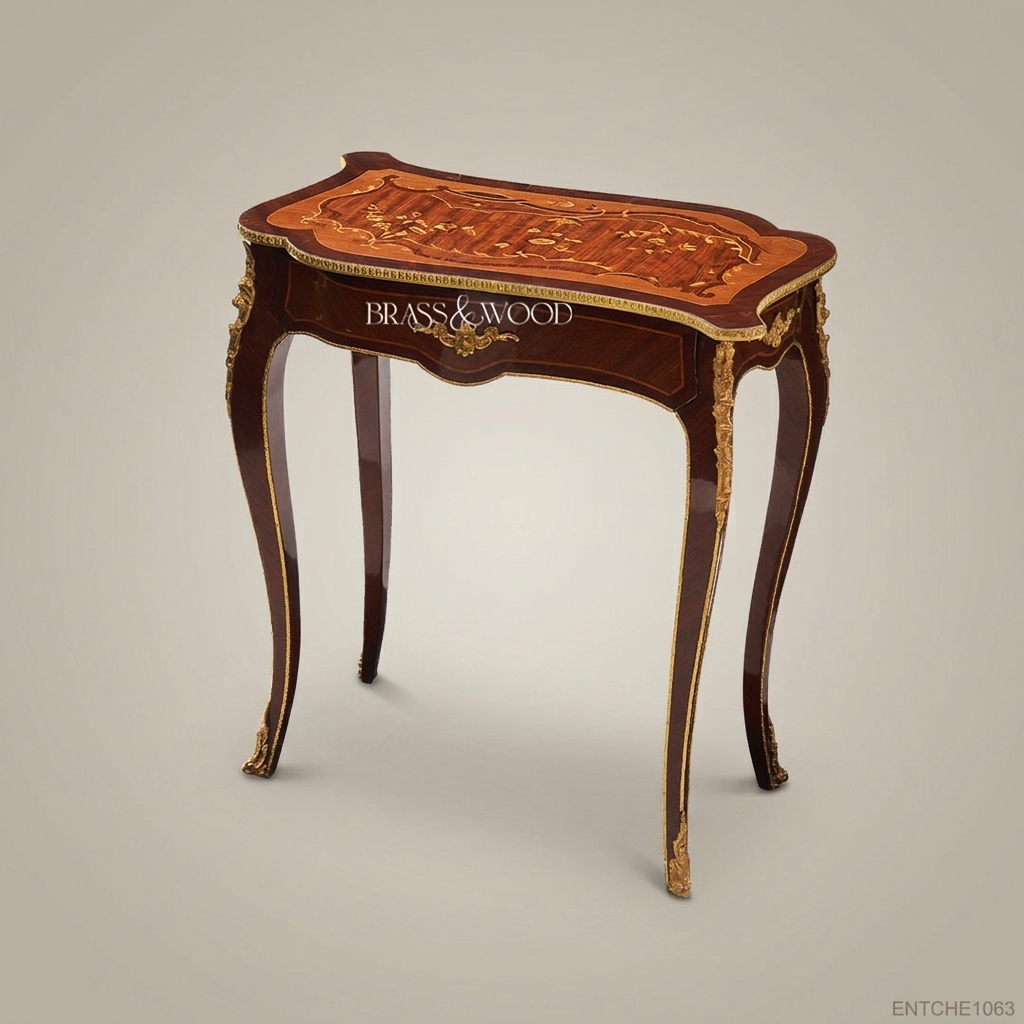
Place this table in a room and it immediately draws the eye to the surface — a dense, intricate marquetry composition that covers every centimeter of the shaped top. This is a Napoleon III Rococo Revival occasional table, faithfully reproduced in the tradition of the great Parisian ébénistes of the 1850s–1870s who worked for the Second Empire's appetite for ornament and opulence. The shaped, serpentine-edged top with its notched corners, the elegant saber-like cabriole legs, and the gilt bronze mounts at every stress point are the unmistakable fingerprints of the Second Empire's revival of Rococo luxury — more maximalist than the original Louis XV, and proud of it.
Materials & Craftsmanship
The table is built on a foundation of Romanian solid redwood (below 10% humidity), hand-cut and assembled by Egyptian craftsmen trained in classical European joinery. The top surface carries a meticulously hand-laid marquetry panel: a central medallion of light fruitwood and satinwood veneers arranged in floral and foliate motifs, framed by a crossbanded mahogany border and finished with a fine brass-inlaid edge gallery — a detail that kept the marquetry panel protected on original writing and games tables of this era. The deep mahogany ground of the apron and legs is finished to a French polish, bringing out the wood's natural reddish depth. A single fitted drawer in the apron is faced with a shaped mahogany panel and centered with a gilt bronze pull escutcheon.
Dimensions & Details
The sinuous cabriole legs, which swell outward at the knee before tapering to a scroll foot, are each capped with cast gilt bronze sabots — protective feet mounts that were both structural and decorative in original Second Empire pieces. Additional ormolu mounts appear at the knee of each leg and at the corners of the apron, cast with foliate acanthus and C-scroll motifs that echo the marquetry composition above. The shaped top overhangs the apron with a subtle serpentine profile, giving the table visual lightness despite its richly ornamented character.
Handcrafted in Egypt
Every element of this table — the marquetry laying, the French polishing, the brass mount fitting, the drawer joinery — is carried out by hand in our Egyptian workshops. Brass & Wood has spent years developing a production process that respects the original techniques: hide-glue assembly, hand-scraped veneer preparation, and individually cast brass hardware. The result is a piece that honors the legacy of Napoleon III cabinetmaking while being built to endure modern living.
Frequently Asked Questions
What materials is this table made from?
The table is constructed from Romanian solid redwood with multi-species marquetry veneers on the top surface, a French-polished mahogany finish throughout, and cast gilt bronze ormolu mounts on the legs, apron, and drawer pull.
Is the drawer functional?
Yes. The single fitted drawer in the apron is fully functional, lined in a contrasting material, and fitted with a gilt bronze escutcheon pull.
Can this piece be customized?
Yes. Brass & Wood offers customization of wood finish tone, brass hardware color, and marquetry veneer selection. Contact our team for bespoke options and lead times.