Specification TABENT6040 · SIMPLE
Specifications
| Dimensions | N/A |
|---|---|
| Weight | 4 kg |
| Materials | Solid Wood, Brass |
| Country of Origin | Egypt |
| Design Style | Louis XVI Neoclassical |
| Ideal Placement | Living Room, Bedroom, Hallway, Reception, Library |
| Delivery Time | 30-45 Days |
| Assembly Required | Minimal Assembly |
| Care Instructions | Dust with Dry Cloth |
| Handcrafted | Yes — by Egyptian artisans |
| Customizable | Yes — contact us for custom orders |
Description
Design & Inspiration
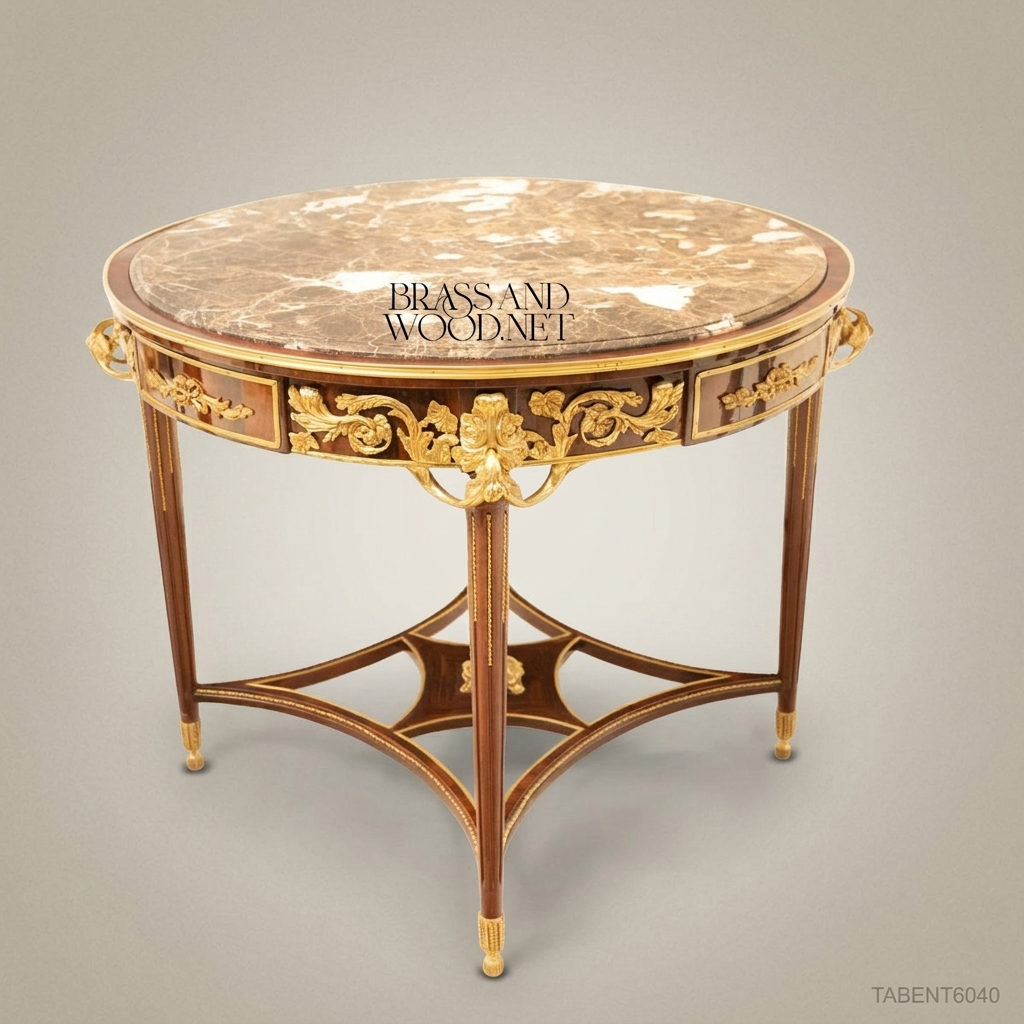
Place this table at the centre of a reception room and the eye finds it immediately — not because it demands attention loudly, but because everything about it is resolved with a calm authority that only refined Neoclassical design achieves. The round form, the warm veining of the Emperador marble, the generous apron dressed in marquetry and cascading gilt acanthus scrolls: this is a table that has earned its place in the room. Faithfully reproduced in the tradition of the great French ébénistes of the Louis XVI period — masters such as Adam Weisweiler and Jean-Henri Riesener — this guéridon brings the measured grandeur of late-18th-century Parisian cabinet-making into the contemporary home.
Materials & Craftsmanship
The circular top is dressed in Emperador marble — its characteristic warm brown ground threaded with ivory and gold veining that catches ambient light differently at every hour of the day. Beneath the marble, the apron is faced in figured wood marquetry panels framed by precise brass stringing, a technique that defined the Louis XVI taste for controlled, geometric ornament. Flanking the single central drawer, large cast-gilt ormolu acanthus mounts spill across the apron surface — each leaf individually modelled, the scrolls full of movement yet perfectly symmetrical in the Neoclassical manner. Four round-tapered legs, fluted and strung with brass bead inlay, descend to a curved X-stretcher — itself centred by a small ormolu finial — and terminate in gilt sabots. Every junction between wood and metal is tight and intentional: the mark of hands that understand both materials.
Dimensions & Details
This round guéridon table is built for prominence without overwhelming: proportioned to serve as a centrepiece in a formal salon, a commanding accent in a wide hallway, or the focal piece of a diwaniya arrangement. The Emperador marble top provides a heat-resistant, durable surface suitable for decorative objects, table lamps, or serving arrangements. The single apron drawer offers discreet storage. The four-leg stretcher base provides structural rigidity while maintaining the visual lightness that distinguishes a Louis XVI piece from the heavier forms of the earlier Baroque.
Handcrafted in Egypt
Every element of this table is produced by hand in Egypt using Romanian solid redwood dried to below 10% humidity — a specification that ensures dimensional stability in the variable climates of the Middle East and Mediterranean. The ormolu mounts are individually cast and finished; the marquetry panels are hand-laid and levelled; the French polish finish is built up in multiple sessions, each coat rubbed back before the next is applied. At Brass & Wood, the replica is not a shortcut — it is the commitment to making a design that took centuries to refine available to those who understand what they are looking at.
Frequently Asked Questions
What materials is this table made from?
The frame and legs are crafted from Romanian solid redwood (below 10% humidity) with a French polish finish. The tabletop is genuine Emperador marble. The decorative mounts are gilt ormolu (cast brass with gold finish), and the apron features hand-laid wood marquetry with brass stringing inlay.
Is assembly required?
Only minimal assembly is needed — typically attaching the legs or the stretcher base, which is completed without specialist tools and takes under 30 minutes.
Can this table be customised?
Yes. Brass & Wood offers customisation options including alternative marble top selections, different brass finish tones (antique gold, bright gold, bronze), and variations in wood finish colour. Contact our team to discuss bespoke requirements before placing your order.